
Shop
Showing 85–96 of 250 results
-


Crease Recovery Tester
The Crease Recovery Tester is used to determine the ability of textiles to recover from creasing by measuring the crease recovery angle. This test evaluates the wrinkle resistance of fabrics by assessing how effectively a material returns to its original position after being folded under a specified load.
In the test procedure, a rectangular specimen is folded and creased under a 1 kg load for a specified duration. After creasing, the specimen is carefully transferred to the angle measurement assembly. One end of the specimen is secured in a spring-loaded clamp, while the other end is allowed to hang freely under its own weight. The clamped end is then slowly rotated until the free end aligns vertically. The angle through which the specimen recovers is read directly from a graduated scale. This angle represents the crease recovery performance of the fabric.
-

Crimp Rigidity Tester
Crimp is a critical property influencing yarn processing behavior during carding and drafting, as well as the occurrence of faults in yarn. Key parameters such as crimp frequency, amplitude, stability, elongation, and decrimping point play a vital role in determining yarn performance.
The Crimp Rigidity Tester is designed to evaluate the crimp rigidity of polyamide and polyester texturized yarns. It enables accurate determination of crimp frequency and amplitude by projecting a magnified image of the fiber onto a screen. The equipment incorporates a tension device to maintain proper tension between the two clamps during testing, ensuring reliable and consistent results.
Manufactured using high-grade raw materials, the instrument undergoes strict quality checks before delivery and is supplied with warranty coverage.
-

Crimp Tester
Crimp in yarn is defined as the difference between the actual length of a yarn and its apparent length in the fabric after weaving. It is usually expressed as a percentage of the yarn’s apparent length in the fabric. Accurate determination of yarn crimp is essential for evaluating fabric structure, performance, and dimensional stability.
The crimp test is performed by marking a known length on the fabric, carefully removing the marked yarn without disturbing its twist, and holding it between two grips at the marked points. The yarn is then gradually extended under a specified straightening tension. The increase in length is measured and expressed as a percentage of the original marked length to determine the crimp value.
The IKON Crimp Tester is specially designed to determine the crimp of yarns removed from fabrics. One end of the yarn is secured in a pivoted loading grip where the required tension is applied using a sliding weight acting on a lever arm. The other end is held in a movable grip mounted on a screw mechanism, allowing it to travel along the yarn’s direction and stretch it. The extension is measured on a scale positioned alongside the grip assembly.
The loading grip is pivoted on a jewel bearing and mounted on a sliding platform to accommodate different test lengths. The selected test length is indicated on a base scale aligned with a pointer fixed to the sliding platform.
During testing, the yarn is stretched until the preset tension—adjusted via the pendulum and sliding weight—is reached. When the specified tension is achieved, the pendulum lifts from its support, breaking the electrical contact and switching off a low-voltage indicator light. The elongation at this point is noted, and the percentage crimp is calculated accordingly.
The apparatus is finished in grey hammer-tone stoving paint with bright chrome plating for corrosion resistance and durability.
-

Crocking Cloth / Crocking Square
Adjacent fabrics are manufactured in accordance with ISO 105 specifications and are tested to ensure historical continuity using established internal standards.
Each batch is verified against an internal master standard to maintain excellent consistency over time.
- Full batch traceability
- 100% inspection for construction defects
- Strict quality control procedures
Cotton Lawn Rubbing Fabric
Designed for use in wet and dry rubbing fastness tests of textiles as per ISO 105 X12, as well as shower resistance tests.
SDC Cotton Lawn is produced in a controlled, clean environment to minimize contamination from lint (fly) containing:
Acrylic, Cotton, Polyamide, Polyester, Wool, and Viscose fibres.
Fabric Limbric (Nylon 6.6)
Used as an adjacent fabric in colour fastness to washing and wet contact tests in accordance with ISO 105 Group C and Group E standards.
-

Cross Hatch Tester
The Cross Hatch Tester is used to evaluate the adhesion strength of coatings applied on various substrates. Even if a coating appears smooth and continuous, this test determines how well it is bonded to the base material. It is widely used in paint, coating, plating, and surface treatment industries for quality control and inspection.
The instrument creates a cross-hatch pattern on the coated surface, after which adhesive tape is applied and removed to assess coating adhesion.
-

Crush Tester
The IKON Crush Tester is designed for evaluating the compressive strength properties of paper and paperboard. It is suitable for conducting Ring Crush Test (RCT) for paper with thickness between 0.15 mm and 1 mm, Edge Crush Test (ECT), Flat Crush Test (FCT), and Ply Bond Adhesion Test (PAT) for boards. The instrument can also be used for Corrugating Medium Test (CMT) on tubes with diameters less than 60 mm.
-
CSP Lea Strength Tester
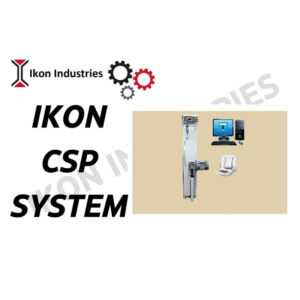
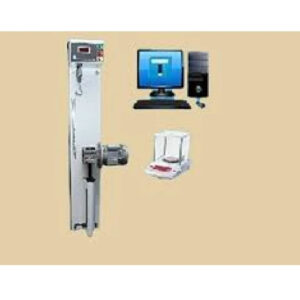
We have established a strong presence in the industry by offering a comprehensive range of CSP Lea Strength Testers designed to meet the demanding needs of textile laboratories and production units. Manufactured using advanced engineering techniques, these testers deliver consistent accuracy, durability, and ease of operation, making them a reliable choice for quality control.
-


De Mattia Flex Tester
The ability of rubber products to withstand repeated flexing without cracking is critical in applications where materials are subjected to continuous bending. The De Mattia Flex Tester is designed to evaluate the flexing endurance of vulcanized rubber by simulating repeated flexing under controlled laboratory conditions of speed, stroke, and degree of deformation.
This test method provides valuable information on a rubber compound’s resistance to flex cracking. During testing, cracks may initiate at points of stress concentration or propagate from pre-existing flaws. Crack growth typically occurs perpendicular to the direction of applied stress, allowing accurate assessment of material durability.
-
Digital Fabric Thickness Tester
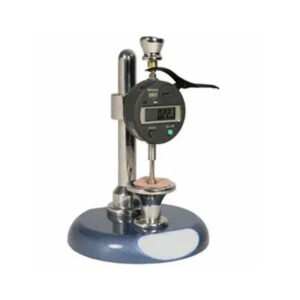
The Digital Fabric Thickness Tester is designed to accurately measure fabric thickness in millimeters, making it ideal for textile quality control and laboratory applications.
-
Digital Fabric Thickness Tester
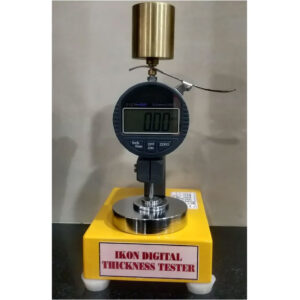
The Fabric Thickness Gauge is a compact and precise instrument used to measure the thickness of textile materials with high accuracy. Designed for quick and reliable readings, it is ideal for laboratory testing and quality control, helping ensure consistency across different fabric types.
-
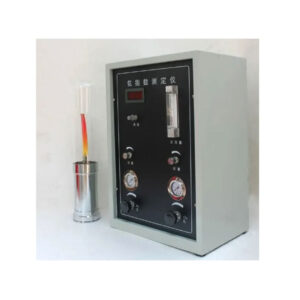
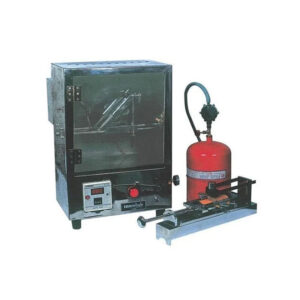
Digital Flammability Tester
The Digital Flammability Tester is designed to evaluate the flammability characteristics of textile materials in a controlled environment. The instrument features a stainless steel safety shield of specified dimensions, open at the top and fitted with a transparent sliding front window for easy observation. A precision opening is provided at the lower front for burner adjustment.
A specially sized Bunsen burner is mounted at the base of the shield with a sliding mechanism for accurate flame positioning.
At the top of the instrument, a vertical clip assembly holds the specimen securely. Two stenter pin plates fitted with pointer pins are mounted horizontally on either side of the shield to prevent movement of the lower end of the specimen during flame application.
The specimen holder consists of two U-shaped stainless steel plates that clamp the fabric at the top and sides while leaving the bottom free. This arrangement provides an exposed test area of 50 × 305 mm. During testing, the holder is positioned vertically inside a draught-free chamber so that the ignition flame strikes the specimen centrally, 19 mm above the lower edge.
All metal components are finished with bright chrome plating and polished stainless steel surfaces, ensuring corrosion resistance and long service life.
Note
Gas supply and gas cylinder are not included with the instrument.
-


Digital Force Gauge
The 500N Digital Force Gauge is a high-precision push and pull tester designed for laboratory force measurement and destructive testing applications. With a maximum capacity of 500N (50 kgf / 110 lbf / 1800 ozf), this digital dynamometer delivers accurate and reliable force readings for both tension and compression tests.
Equipped with a precision internal sensor (±0.5% accuracy), clear digital display, and multiple unit conversion options, it is ideal for testing cables, springs, wires, packaging strength, electronic components, textile materials, and mechanical parts. Its rechargeable lithium battery, compact design, and user-friendly interface make it suitable for quality control labs, R&D departments, and industrial inspection use.
Suitable for destructive test mode, peak hold measurement, and continuous force monitoring, this digital force gauge ensures dependable performance across various testing environments.